Wednesday, September 15, 2010

A Rant About U.S. Universal Healthcare

There is so much rancor out there right now regarding the U.S. Universal Healthcare (legally known as the Health Care and Education Reconciliation Act of 2010) and the country is starting to believe, majority-wise, that universal healthcare is a bad thing.

Most people seem to be in fear of the cost of the plan, as in dollars. I tend to think about the cost to people, as in human beings.

The Kaiser Family Foundation, "a non-profit, private foundation dedicated to providing information and analysis on health care issues in the U.S." has done extensive research and analysis on U.S. healthcare.

Here are some of their findings:

* In 2005, the U.S. spent $2 trillion on health care, which is 16% of GDP and $6,697 per person
* Health care costs have grown, on average, 2.5 percentage points faster than U.S. GDP since 1970
* Almost half of health care spending is used to treat just 5% of the population
* Prescription drug spending is 10% of total health spending, but contributes 14% of the growth in spending
* While about 26% of the poor spent more than 10% of their income on health in 1996, the number increased to 33% by 2003
* Many policy experts believe new technologies and the spread of existing ones account for a large portion of medical spending and its growth

These are very sobering statistics and here is one more, 32 to 46 million Americans, of them 9 million children, have been without health insurance in the U.S. That is more than 10% of the population.

And we are all to blame for the increased costs in healthcare. We choose to take drug after popular drug based on our own neurosis, and worse, we shove drug after over-prescribed disorder drug to our children.

We are the most obese and sickly citizens in U.S. history and we take on the least amount of exercise than any citizens before us. And we are possibly raising the first generation to live, on average, fewer years than their parents. I hear gym classes are not even mandatory in many school across our country.

And all of this has happened over time, this did not become the norm over night. And yet screaming blabbermouths on the air scream "Obamacare!" like it's the threat of the nation.

Personally the threat of the nation is 46 million uninsured people going to emergency rooms across the country for colds, sprained ankles, scrapes and other conditions that could have been handled by a competent doctor in his/her office with an appointment, if they had healthcare.

I'm also wondering when we became such a selfish country. To think 46 million people without health insurance is a better system than universal healthcare is just unfathomable to me.

Partly I think people are not looking at this issue on a human scale. Look at your extended family of say, 50 people. Now of that group, choose 10% of them and tell them they cannot have health insurance. Look at your niece, tell your grandfather, tell your child, "sorry, health insurance is not for you".

You can't do it, right? Well, we do it as a country every day, but no one has to go out and tell an American that you can't have health insurance, it is just part of being a free country. The markets decide who can and who cannot afford health insurance coverage. It's easier when no one has to take responsibility for it.

It's time to stop being such a frightened and paranoid country and to start making bold moves to ensure each and every citizen has the rights and freedoms to be healthy, happy and strong. And that includes ensuring each and every one of us has adequate, safe, and cost-effective health insurance coverage. No one should have to choose between dinner and a pill. It's not going to be easy and it's not going to be cheap, but what is more humanly expensive than 46 million Americans without health insurance?

Sunday, September 05, 2010

A Friend's Farm and Project

Growing up in New England and in a small town, you see and learn what small-farming is about. We lived in 'milking country' and had many family-owned farms around us.

Today we hear about the problems with intense-farming and corporate farming and the destruction they are having on our environment (polluting under-ground water and rivers and streams) and destroying our country's food supply.

So when a person or family is trying to produce top-quality, local, long-lasting products, you want to do what you can to support them.

Here in California we have many family-owned farms in and around the Bay Area who make cheese, raise organic chickens and sell organic free-range chicken eggs as well as all of the wonderful organic foods grown in the valley here.

I have a school friend who has a pre-civil war farmhouse and is running a sheep farm in Virginia. The lambs she is raising are rare and quite stunning to look at (I've only seen photos) and I have asked her to create a lamb's wool blanket for me.

My friend, Nancy Chase, and her farm, Ingleside Farm, and her story, can be found here: Ingleside Farm

Here is the design of the blanket (personally designed by Nancy):


and here are a couple of the lambs that will be providing the wool for the blanket:


This is Xenophon


This is Windsor

Aren't they just beautiful, beautiful animals!

Please think about your local family-owned farm. Buy their eggs, their cheese, and their other lovely products. You and your neighborhood and this country will be better for it.

Sunday, July 11, 2010

Brief Review of PBS's Masterpiece Mystery! Murder on the Orient Express

I would have to say an interesting adaptation of Agatha Christie’s ‘Murder on the Orient Express’.

The acting was superb all around, the writing was well done but let’s make no mistake, it was an adaptation, not a legitimate expression of Agatha Christie’s intent.

For someone who has read Agatha Christie since I was a child, this was not the Poirot that I know nor is it the Poirot Agatha Christie knew.

Poirot had more control, had much more pomposity and would not have shown his emotions in such a raw form, which is what made this an intriguing adaptation.

The story is a powerful one that all of us take ownership of, which makes it hard for us to watch when others take liberties with the author’s intent.

Interesting adaptation but I felt Poirot’s character was not held to Agatha’s standards and unfortunately neither was the plot. I don’t think I would have enjoyed it as much if the acting wasn’t so brilliant (or the cinematography for that matter), but in the end, I was let down with a director and writer who felt their views and visions were more important than Agatha Christie’s and that I cannot forgive.

Sunday, July 04, 2010

A Note to Jeffrey

Hi Jeffrey, it’s been awhile, I know.

Today is your birthday and something tells me it was stellar!

What did you do? Man I wish you could tell me.

My life has been an interesting one since you and I met last. Let’s see, where to begin…

1) My grandmother died shortly after you. She, like you, had a wonderful life of friends and family.

2) I continue to see the world. Went to one of your spots, Puerto Vallarta, with 9 friends and had a freakin’ blast! Met an 81 year old lady from Scotland whose dad moved the family from Scotland to Mexico when she was 3. She met her husband when she was 17 and they married when she was 18. She has a great collection of art that she and her husband have collected through their 60+ years of marriage. Don’t you just love randomly meeting those awesome people in the world?

3) Atlassian is still growing by leaps and bounds, you would be so proud!

4) I had a really good browny that liked me less than I liked it, but we grow as people, right?

5) Heading back east to wonderful Martha’s Vineyard, which you know is one of those special places in the world.

6) Off to Sydney and Amsterdam later this year. You would be thrilled with how Amsterdam is going.

7) I’m going on my first trip to Vegas and with my family. Can you believe it? I can’t either but it’s happening.

8) Britt and Mac are doing well. I would tell you all the gossip but you always knew what was happening before I did, so I will let you tell me the next time we speak.

9) Jessy, gosh, Jessy. Jessy is doing well, Jeffrey. She has amazing friends and family and we all love her dearly and she, like all of us, just miss you terribly and wish this was all a bad dream.

I wish we had more time, but I think it’s time to say good-bye for now.

For now, Jeffrey, ciao and we’ll talk again.

I love you and these tears, oh these painful tears will dry and I will smile the next time I think of you. Just not right now.

Ernie

For those of you who may not know, this is Jeffrey: http://radiowalker.wordpress.com/

Tuesday, September 08, 2009

A Test of Strength? No, LIFE

It has been a very trying time in my life. The death of my boss and mentor has jolted me to the core. I thought, as with all of his trials, he would triumph. How do I let go, how do I say good-bye to someone who has impacted me so greatly?

On top of this, my grandmother, whom I love so dearly, is starting her first major battle with sickness at the age of 96 (she had to have a pace-maker put in a few years back). If we could all be so lucky. The doctors have said there is nothing they can do and slowly my grandmother's heart and body are degenerating. Her mind is sharp and she is able to move about of which the family is very fortunate and grateful to still have and enjoy.

Additionally I just found out my 42 year old best friend had to have two lymph-nodes removed from her neck after having an abscess in her tooth that then caused her lymph-nodes to swell to an extraordinary size. All tests have come back negative, cancer and sexually transmitted diseases, but the oncologist is very concerned and the lymph-nodes have been shipped to Maryland for further tests.

This is a lot for anyone to manage, singularly, on their own; one battle at a time please, but to have to grieve and worry through all three is a new challenge.

Not to say I have any difficulties compared to my mentor's family or what my grandmother is personally going through, wondering when the next phase will begin and what that will be. Imagine hearing from the doctors there is nothing they can do. And my friend, my dear friend, having to wait for the results of the further tests, wondering if she will begin the battle with a form of cancer or some other unknown-at-the-moment condition.

With my boss's death, people are saying, 'I was meaning to visit him' or 'I wished I had called'. With my grandmother, the family wonders if there is more we could have done or can do now. And with my friend, we all hope the results come back negative and that we have many more years to spend with her.

I have found through other losses in my life, there really isn't enough time. My family is very close and they have spent thousands of hours with Grammie and I saw Grammie at least weekly, but, of course, we wonder 'could we have spent more time, could we have experienced that time with more love and attention?' 'Could we have brought her more joy by doing more things?'

Only one person can answer that question and we seldom dare to ask. A common phrase is "life gets in the way". I'm sure each of these people have said those exact words about another person in their life who is no longer living. Why do we question our connections at the time of possible departure or after the death of someone? Wouldn't it be better to evaluate and re-evaluate all of our relationships? Maybe I should put in my calendar, monthly, an examination of one friend or a few friends or family; what have I done with them this past year, what can I do to let them know I love them?

I know, it won't happen and I don't think it's practical, really. Family is family, we are stuck with the good, with the difficult and with the continued drama that close-knit loving people endure. Would you really want it any other way? Friends are people we choose to spend our time with. We get something in turn from our interactions. They know us on a level that family doesn't, and they continue to choose to be with us as we continue to be with them.

My boss and mentor taught me to experience life to its fullest. I have heard that all throughout my life from those who regret decisions they have made in their past and from others who wished their lives were different. I am fortunate. Though my life is not perfect, I am pleased with my choices and where I am in my life. Yes, I would make a lot of changes along the way, if I had the chance, mostly to avoid the pain and heart-ache of past mistakes and choices that did not lead to a great conclusion. But we don't have that ability, and neither do the 3 wonderful individuals I talk about here.

What we can do is remind our family, our friends, our loved ones that they are important, that they matter, that you love them and you wish and hope for nothing but joy and happiness in their lives and a painless and long-way-away death surrounded by family and friends with the knowledge you did everything you wanted to do and you told everyone you wanted to tell that you love them... and I DO love them oh so much.

Wednesday, September 02, 2009

My Heart Aches

Today I grieve for the loss of an amazing life.

Read his blog: http://radiowalker.wordpress.com/

If you have not met Jeffrey, you truly missed out. Each of us who knew him and were enveloped in his passion for life were really, really fortunate. The ride, at times, might not have been smooth sailing, but damn it was a hell of a lot of fun!

I could say more but, frankly, I'll let the man speak for himself.

Read his blog, experience his life. He truly is an amazing life.

Saturday, May 23, 2009

Present is past

Talking to friends on the Vineyard and listening to James Taylor makes me think about years past; growing up in Maine where family was always around.

Growing up in Maine, I had a very large, extended family. My mother was one of 6 and each of her siblings had children and even some of their children were having children.

I must have had 20 or more cousins (at least it seemed that way) and I was the youngest or one of the youngest of the gang so I learned a lot from them that maybe I wouldn't have learned about until later in life if they weren't around; things about family gossip, sex, smoking, dirty language and all the other things that move us from the clutches of innocence to the realm of reality.

Innocence may be nothing more than ignorance but I do think of my childhood fondly. I was so fortunate to be brought up in the bosom of love and care. I felt it with every smile, every wrinkling of the nose from my mom, every warm hug from Nana, every laugh from a cousin, every night I went to bed, knowing when I got up in the morning there was a family, oh so eccentric, unbelievably funny, all too often annoying, just a little bit crazy, and more loving than anyone could ever imagine; there to say to me, with the warmest of hearts, "good morning".

More to come.

* * * * * *

We glide along the night darkened country roads warmed from the hot summer day. We are returning from a day of swimming at the lake and being with family and friends. The caressing breeze cools my face and neck and I hear, in the distance as we ride by, frogs and crickets and see the familiar and welcoming flickers of the fire-flies in the fields passing by. I look up into the pitch-black night sky and I can millions of far-a-way stars and planets flickering, like the fire-flies in the fields below.

There are no street or porch lights to shine our way, just the limited focus of the car's headlights, which are no match for the darkness of these impenetrable ancient woods. No words are spoken, no music is heard other than that from the night creatures of rural Maine.

This is a familiar scene for me, growing up in rural Maine. Summers are about being with family and friends, swimming in sun-warmed lakes, sand in our feet, bug bites on our arms and legs and no worries in our souls. Just thoughts of what we would be doing tomorrow during another long summer day and night.

* * * * * *

Crickets creek, frogs shreek, fire-flies blink and I am looking up at the warm summer night sky wondering who, so far away, is looking back.

* * * * * *

Saturday, April 04, 2009

Amsterdam

"The verdure of the trees reflecting strongly upon large windows which are kept bright and free of dust, add infinitely to their luster and magnificence." wrote a visiting American back in the 1700's.

This succinctly explains Amsterdam to the modern traveler as it did during the revolutionary years of Europe and America.

The brick and stone buildings shine with spotless oversized windows that reflect the branches and leaves of the tree-lined canals.

Amsterdam is a place you must experience, rather than just explore. My first visit in 2000 was about exploring, visiting the sites, going to the Keukenhof and the cheese auctions in Alkmaar. My time was spent mainly in the center between Centraal Station and Dam Square, very bustling and busy and hosts to the travelers and locals who like the adult night life. Because of this, Amsterdam did not enthrall me as Paris, Egypt or Bruges did and still do.

This time I came to work and I've done more than just explore, I've experienced Amsterdam, and now I have a very different perspective of this place of 700,000+ people. There are the frustrations of running a business in this aged and lovely city, but there are also the triumphs and joys of spending one's precious time here.

Let's start with the basics.

Amsterdam began to emerge from a sleepy fishing village in the late 1200's at the mouth of the Amstel river. Lords van Amstel feuded with counts and bishops that lasted for another century.

By the late 1300's, controlled by the Dukes of Burgundy, the little city perfected the method of curing herring (in 1385) and started to become a truly rich port as it also became the stopping ground to export beer and other wares from its mutli-purpose built homes that were also warehouses.

In 1452, the second major fire caused legislation that outlawed any buildings being constructed of wood. A few years earlier the marriage of Philip the Good of Burgundy to Isabella of Portugal put the Low Countries (as Netherlands was known at the time) in control by the all powerful Habsburg dynasty. FYI: Philip's son, Charles the V became, in later years, the King of Spain.

In 1568, the Dutch Revolt under William of Orange (a Protestant) arose and the power of the Catholics eroded quickly and within 10 years the Alteration occurs, where the Catholics are expelled from Amsterdam. William of Orange was assassinated in 1584, when he was shot on the staircase of his quarters in Delft (not sure if any of his porcelain broke from the shot).

In 1634 tulip mania begins in Amsterdam and Rembrandt becomes a Dutch sensation and in 1648, after many decades of war with Spain (80 years), the Treaty of Munster ends the fighting and the Netherlands is born.

For the pilgrims of the new world, later these United States of America, prior to sailing across the Atlantic, they went to Leiden to escape persecution from the British and stayed for 11 years before setting sail in 1620. There is a museum in Leiden describing their time in the Netherlands.

The 17th and 18th centuries were of great expansion and creation of wealth for the people of Amsterdam, including the creation of the East India Company as well as it's expansion around the world, including New Amsterdam, later to be called New York City.

In the 1960's, as in other parts of the world, strife and riots shook Amsterdam and droves fled the city and not until the late 1980's was the city once again a place of tranquility.

For those who are use to loud noises from city life, Amsterdam has to be one of the most silent cities in the world due to the few cars, relatively speaking, that travel throughout its streets. But when you are at street level, the site is anything but tranquil. There are throngs of people, bicycles, trams and mopeds and each one is plying their way through the narrow streets of Amsterdam. But, thankfully, most go about without any incidents of crashing into one another, it's actually quite remarkable!

When you visit this city, and please spend at least a week, rent a bicycle, it is the only real way to get around. Their bikes are single speed and many do not have hand breaks, just use your pedals to break. It takes getting use to. Many of the bikes are Chinese made and they sound it... the clanking of cheap metal can be constantly heard along bike paths all over the city. New and shiny just is not seen in the bikes of Amsterdam.

Amsterdam is a city that loves the arts and they have many museums, some are famous, like the Van Gogh and Rijksmuseum whereas others are unique, like the Torture Museum, Hashish and Marijuana museum as well as distinct as the Bag and Purse Museum.

The most famous is the Rijksmuseum which holds some of the cities best and most valuable works of art.

There is a lot of construction going on at the Museumplein at the moment, with renovations happening at the Rijksmuseum and with the just-begun new construction at the Stedelik Museum, which will be a white box made of what looks like fiberglass (but one can only guess - possibly cement) with a very large overhang. This is the upscale part of Amsterdam with extremely large homes and expensive international shops all within walking distance of the 1860's built Vondelpark with its English inspired landscape covering 110 acres.

The I AMsterdam is a campaign to advertise this fascinating city. Art can be found all over Amsterdam, from the classical to the modern, from the religious to the outrageous, as you can see below.
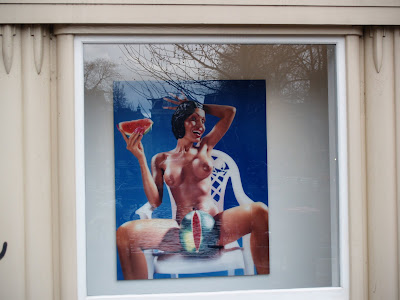
Art can be VERY subjective.

Of course the Netherlands is known for it's tulips and a trip cannot be complete in the Spring without visiting one of its flower attractions. The Bloemenmarkt is the last remaining floating flower market in Amsterdam and it is very touristy, selling bulbs that are shipped all over the world.

Bloemenmarkt is one canal long and not anything special. For the truly outstanding, go outside of Amsterdam where the real flower gardens are to be found.

One of the charms of any city is to find a place that makes you feel welcomed. Mine was this little watering hole next to a more famous pub Cafe Belgique. But I like this one much more.

This great little watering hole is called Bols Proeflokaal De Drie Fleschjes and is located at Gravenstraat 18 and is owned by a man who lives the good life. He opens it up when he feels like it and he hangs out with the patrons while a bartender tends to their needs. They rent out the barrels to businesses and when the barrel runs out, you either buy another fill or another name goes on it. A great little spot that is not too well known but well worth a walk-by to see if it is open. They sell great beers (some from Belgium) and some Dutch gin (genever or jenever) and their phone number is: 020-6248443.

Of course one of the greatest draws are the canals. Amsterdam first started with the Amstel river and as time went on, the fishermen and farmers diverted some of its water into canals and over time, more and more fortified canals were built to make Amsterdam the water-laden city it is today. It is actually below sea-level, with only the heart of the center of Amsterdam being about 7 feet above sea water.

Boathouses on one of the many canals in Amsterdam. At a time, not too long ago, it was cheaper to own a houseboat than it was to buy a house or flat, but the city felt too many houseboats were congesting the city's canals, so increased taxes have now made living on a houseboat a luxury or a privilege rather than a convenience of euros. Many of them are floating gardens and hold a romantic voice in peoples' hearts and minds, even from those people who are just floating by.

One way to see the sites from the canals is to take one of many canal boat rides that are available to all, for the right price. But if you are lucky, as I was, ride with a local, the time spent can be quite wonderful.

The Atlassian Amsterdam office crew had the good fortune of doing just that. Valerie, who is part of our partner program and who is responsible for the European partners, invited us on her boyfriend's (Nicholas) 21 foot boat to cruise the canals in what was definitely the nicest weather Amsterdam has had in 2009. It is late in the evening and I still didn't need a jacket.

Atlassian crew enjoying the ride along the canals in Amsterdam.

You see many of amazing buildings - grachtenhuizen (canal houses) - all along the route. Many buildings built in the 1600 and 1700's with some later in the 1800's and even the 1900's.

This row of canal houses are on the Herengracht many of which were built in the 1600 and 1700's. Some of them may be leaning a little to the left or the right, but they still show their true majesty after 350 years.

Amsterdam has many styles of buildings which most were built after 1521 (since they are of stone) and the 1600 and 1700's are the majority of the buildings.

This row of canal houses is unique since all of them have shudders

I also love this row of canal houses with their lovely red shudders

One of my favorite buildings is currently the Theatermuseum. I am hoping to go inside later this week. The Theatermuseum was built in 1617 and was known as the Bartolotti House and was built in the Dutch Renaissance style of Hendrick de Keyser. This building is located at Herengracht 168.

Another of my favorite buildings is the Concertgebouw or Concert Hall in the Museumplein.

Concertgebouw is a Neo-Renaissance building that was open to a public architectural competition and the architect AL van Gendt won. There are two music halls and the Grote Zaal (main concert hall) has almost perfect acoustics even though the architect had no musical knowledge. It's first concert was on April 11, 1888 with 160 musicians and a 600 person choir. In 1983 the foundation was having subsidence issues and the entire building had to be lifted to remove the old original supporting piles, which were 43 feet deep, and pour in concrete pilings that are now 59 feet deep.

And here we have reflections on a canal.

Canal houses reflected on a canal

One of the more famous areas is that of the 7 bridges. Since we were boating through it, I only got photos of half of the bridges, but it is still amazing to see.

Part of the seven (7) bridges, which is one of the most photographed in all of Amsterdam.

As we were boating along, we heard this music and found this.

A Rock and Roll band were standing in and on an American car while playing and singing to the crowd.

On the eastern side of Amsterdam, we found this pizzaria.

Boats motor up and give their order and in a few moments, pizza is handed through the window at this pizzaria.

One great event during our evening of boating was Sherali's daughter got to be captain.

Our new captain Jasmine drove under 5 or more bridges and did a spectacular job... we were all so proud of her!

For three times now, I have run into this canal performer and sure enough, during our boating, I saw him again!

This canal performer blows his horn while cranking his organ and maneuvering his boat... and he actually sounds really good.

One of the more famous sections of Amsterdam, also on the east side, is the Red Light district.

The Red Light district is famous and infamous for the women in the windows and the legal prostitution. People in the business are treated with respect and have public and business clout. Just another example of the tolerance that is Amsterdam.

As stated before, Amsterdam is a very quiet city, especially outside of the center, you just don't have those constant city humming noises that you do in most others and in the early nights it is even quieter, quite serene actually.

This is one example of a canal at night with lights reflecting off a calm, benevolent canal.

So why the three XXX's on flags, posts and elsewhere?

For many people, it represents pornography and debauchery, which Amsterdam is well known for, but in fact the flag of Amsterdam depicts three Saint Andrew's Crosses and is based on the escutcheon in the coat of arms of Amsterdam. The flag was adopted on February 5, 1975... so there!

One of the most interesting and peaceful places in Amsterdam is just four blocks from the frenetic Dam Square is the Begijnhof.

Begijnhof from the outside.

Begijnhof - English Reformed Church was built in 1419 for the Catholic sisterhood sanctuary known as the Bengijntjes for single women who did not take monastic vows but educated the poor and took care of the sick. The church was turned to a Protestant denomination following the Alteration in 1578.

the green past the church.

Begijnhof Chapel, across from the church, still holds symbols of its Catholic past.

People continued to practice their Catholic beliefs, in secret, at the Begijnhof Chapel until 1795 when tolerance returned, including religious freedoms.

Begijnhof - Het Houten Huis - No. 34 - is the oldest building in Amsterdam from around 1420 and one of the two remaining all wooden structures/buildings in Amsterdam since the city banned wooden buildings in 1521 due to devastating fires and also since most of the buildings in the Begijnhof were not built until after the 1500's.

Begijnhof - Palm Sunday celebrations, surprisingly, no palms, but some other branch was used as the reverend spread holy water over his congregation. Plaques that came from some of the buildings at the Begijnhof can be seen on the far wall.

These are close-ups of the various plaques that came from the buildings inside the Begijnhof. Of course they have a religious note about them. If you can guess what they say or are about, good for you. I'm still guessing.


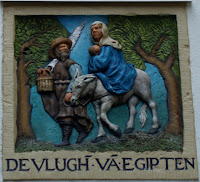
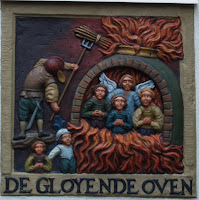


A truly magnificent spot just north of Vondelpark is Hollandsche Mangege, or the Netherlands Horse School. This building opened in 1882 and was designed after the Spanish Riding School in Vienna. In the early 1980's the building, and school, were threatened with demolition but due to a major outcry from its neighbors, funds were raised and the school continues today.

Hollandsche Mangege's beautiful entrance.

Hollandsche Manege - a sweet horse who just wanted to say hello.

One of the two large corrals where students can learn how to ride as well as how to train their horses. Each of the students, on top of getting lessons, must perform duties at the Hollandsche Manege, like feeding the horses, cleaning the stalls and taking care of their gear.

The cafe overlooks one of the corrals. Barring the smell of horse manure, it is quite lovely.

These are the horses in the Hollandsche in 2007... oh so cute.

Sunday, March 29, 2009

Adaptation

What makes an otherwise intelligent human being make the choices we make when we fly?

For instance; sitting in a seat that is too high for one’s legs to comfortably be parallel to the floor for, oh, say, 10 hours and to do it happily?

What otherwise intelligent human being would take the idea of eating food that is at best, bird feed, and at worst, 100 year-old landfill?

I receive a meal known to the airline industry as breakfast. It consisted of a quite tasty strawberry banana yogurt and some kind of breakfast sandwich that when opened revealed a meat with puss-like white edges and a cheese that probably looked its best when it was still in the cow’s utter as milk. Upon further investigation, the bread was completely devoid of any resemblance of actually having yeast used in its baking, if that’s what you can call it, baking. Actually formation would be a better word.

You would be right in suggesting other airlines may have better foods, say Air France would have decent cheeses and breads, and wine, but let’s face it, it’s still cheese, bread and wine that you would never eat and drink in a French cafe, or a French home.

But we do it, we do it once, twice, maybe even three times a year or more because we are, if anything, adaptable creatures. If it means I must eat a block of bread and a cheese so colored that one wonders if it was dipped in Cheez Whiz prior to being boarded, then one does so to end up at their final destination, whether it be Paris, San Francisco or Sheboygan. Sometimes it is the destination and not the journey.

Saturday, July 26, 2008

Paris!

Sunset over the Seine

I was in Paris from Monday, July 7 to Monday July 21... which means I was there for Bastille Day. Every visit I make to Paris just confirms my love affair with the most wonderful city in the world... well at least for me.

At the bottom of this post I will list what helped me, what suggestions I would give and my do's and don'ts of Paris.

- - - - - - - - - - - - - - - - - - - -
A little history about Paris.
- - - - - - - - - - - - - - - - - - - -

Its earliest inhabitants are from around 4200 BC and mostly on the Ile de la Cite. A sub-tribe of the Celtic Senones called the Parisii lived here. The Romans came and conquered Paris in 55 BC due to the river Seine, which had deep waters that could carry very heavy loads, not too swift currents and stable banks supported by hard turf or stone. This made Paris an ideal place for fishing and for armies since the only way to get to it was via the river Seine.

The Romans loved their Lutetia (as they called Paris) and wanted to make it the Rome of the west. But in the 5th century AD the Franks showed up and kicked out the Romans and named it Paris after the early tribes known as the Parisii, then Atilla the Hun arrived and was purported to have murdered 11,000 virgins on their way to Paris, but by a change of plans, Atilla went to Orleans to deal with the Visigoths and spared Paris. This was envisioned by a young girl name Genevieve, who later became the patroness of Paris, St. Genevieve.

In 1,100 AD the first King Dynasty was created by King Philippe Auguste and his families reign lasted until 1314.

2nd Age arrived with Henri IV and his families dynasty lasted until 1643.

3d Age arrived with Louis XIV and his families reign lasted until the 1789 revolution and returned until 1795

4th Age arrived with Napolean from 1795 to 1815 with his banishment to Elba. He returned only to be banished once more... this time beyond his life.

The 5th Age was the Paris Commune, a powerful group of men who ran the city/country from 1815 to 1871. With the 3rd revolution they were gone and followed was a more democratically elected group of governors and leaders.

6th Age was the Treaty of Versailles after WWI, which, as we know, catapulted the world into WWII and in 1940, the de Gualle years began, albeit as a General, and then he disappeared until one falling government after the other (dozens in less years) and until the people called for his service to his beloved country. de Gualle was in power until the 1969 student riots from the Sarbonne (as student riots around the world proved to be a potent change in national/international politics). de Gualle just didn't want to do it anymore, and the new age came with Mitterand and others.

- - - - -

Les Marais

Les Marais is one of the oldest neighborhoods in Paris and was for the Aristocracy for many years until the move west left Les Marais less than ideal. It became a home for the less fortunate and even Place des Vosges, the quintessential Parisian square was slated for destruction at one time.

Since the 1970's les Marais has had a kind of renaissance of its own and it has become the place to live again. It is away from the throngs of tourists that you find in other parts of Paris and you are so close to the river, to public transit, great parks, wonderful museums and little pockets of lovely neighborhoods that it is surprising it ever became an undesirable place to live. Rue de Rosiers is a wonderful Jewish community that is quiet on Saturdays but thriving on Sundays. Les Marais is also the unofficial gay neighborhood of Paris with many clubs, shops and restaurants catering to the gay clientele.

Les Marais was perfect for us, we loved every minute of it. I would stay in Les Marais when I return... and I WILL return.


Our Life in Paris

Our apartment in Les Marais was wonderful with 2 bedrooms, a shower/bath, washer and dryer and wonderful windows that opened into the garden courtyard.

We spent many an evening in the living room talking about our day and/or planning for tomorrow. I would usually sit by the window and download my photos on my laptop on the small table between the two lovely windows. We had great breakfasts of delicious fresh fruit, baguettes and brie (Brillet Savarin). I miss it so much!

Fromager - ask for the Comte (18 months) and Brie called Brillet Savarin (like butter only better)

On our way to the Cafe Musee in Les Marais we saw this cat sitting on a scooter

Cafe in les Marais

Cycling in Paris

Interior of the Metro

Interior of the Metro

Interior of the Metro


Buildings in Les Marais

Some of the rarest buildings in paris from Medieval time, 1400's. Most of these buildings were torn down to make way for wide streets and to prevent the ever-present fires

Old city wall in Les Marais, built in the 1200's

Buildings in Les Marais

Buildings in Les Marais. I liked this building near our apartment for two reasons. One: the unique idea for hanging planter boxes by putting a rod across their courtyard. The other is you can trace the track of the chimney's to their ultimate destination, the smoke stack

Buildings in Les Marais

Buildings in Les Marais. This is a great example of Haussmann's grand renovation of Paris in the mid to late 1800's (1852 to 1870). Baron Georges-Eugene Haussmann worked for Napolean III, Napolean I's nephew.


Place des Vosges

Place des Vosges has existed for more than 400 years. It has a symmetry that is unmatched almost anywhere in the world. Its 36 house (9 on each side) has a beautiful garden in the middle surrounded by stately homes all with the same style roof, stone and brick, but each has its own wrought iron style and may have different decorations on the outside of their windows and archways. It was built from 1605 to 1612 by Henri IV and was the first royal city planning of its kind. Henri II was killed during a tournament at the Tournelles (jousting) and through their grief families tore down their stately homes and moved to what is now the Louvre. At its inaugural it was named Place Royale and was used to celebrate the wedding of Louis XIII to Anne of Austria. The Arcades are used for shops and eating. Even though it was called the Place Royale, no royal ever lived at Place des Vosges.

This is a lovely restaurant where we often ate breakfast, Ma Bagnogne. Their petit dejeuner is scrumptious with their buttery-good croissants and hot chocolate.

People eat their lunch here and bring their children to play (there are seesaws and dirt boxes). We noticed during the week it is mothers who tend to the children, but on the week-ends it is a veritable father's park... as well as many tourists walking through

One of four Cortot's fountains, from 1825


Hotel de Sens

Hotel de Sens has a storied past. It is a Medieval structure, meaning built in the 1400-1500's (1475-1507 to be exact) and it is a private residence (Hotel refers more to a private mansion than a place to crash after a long trip), originally for the Archbishop of Sens (Paris was a part of Sens at this time) and then through its history Nostradamus lived here, as did one of Henry IV's wives, Marguerite de Navarre (known as Margot and she looked into the courtyard, in amusement, as her new younger lover slayed her older lover - not the King). During the 1830 revolution a cannonball was shot at the Hotel and you can still see it in the wall (see photo below). There are interesting protective barriers, including chutes that allowed for scalding hot water to be poured down on intruders and there is a dungeon to hold prisoners.

See the cannonball, it is over 170 years old and still embedded into the Hotel.

Balcony in the courtyard of the Hotel de Sens

The gardens to the back of the Hotel de Sens

A tiny dragon above the back door of the Hotel de Sens, that opens onto the lovely gardens


St Paul St Louis Church

This church is from 1627 with a 180 foot dome. Delacroix's Christ in the Garden of Olives can still be found in this Jesuit Church. It is on St. Antoine in Les Marais.


Izrael - spice shop

A wonderful spice shop in the Marais called Izrael at 30 Rue Francois Miron +33 1 42 72 66 23. They also sell great meat/cheese/spinach pockets and seasoned artichokes for a nice appetizer.

Inside Izrael, an awesome spice shop, and more! Located at 30 Rue Francois Miron +33 1 42 72 66 23 in the Marais


St. Gervais - St. Protais

This lovely church, located in Les Marais is from the 6th century! It is named after two Roman martyrs (killed by Nero),


St Gervais St Protais stained glass


Musee Carnavalet

Musee Carnavalet is one of the state run museums, which means it is free admission. What is unique about this museum is in encompasses two beautiful buildings that were stately homes and they have recreated many of the rooms as well as other unique rooms/stores from various periods of Paris' past.

The museum occupies two adjoining mansions (the Hotel Le Peletier de St-Fargeau and the Hotel Carnavalet). The main building, The Hôtel Carnavalet, was built as a town house in 1548 by Nicolas Dupuis. The Hotel Carnavalet is a Renaissance jewel that in the mid-1600s became the home of writer Madame de Sevigne. The 17th century Hotel le Peletier was added to the museum in 1989 to contain the larger part of the museum's 20th century interiors.

Elegant staircase

Louis XV room contains art from the Bouvier collection and paneling from the Hotel de Broglie

Detail of the wall panelling in a music room

Musee Carnavalet window overlooking garden

Ballroom of the Hotel de Wendel

Ballroom of the Hotel de Wendel


Signs used by shops through various centuries

Musee Carnavalet Fouquet Jewelry Boutique from 1900 is an Art Nouveau decor from Rue Royale and is by A. Moucha

Musee Carnavalet Fouquet Jewelry Boutique from 1900 is an Art Nouveau decor from Rue Royale and is by A. Moucha

Musee Carnavalet Fouquet Jewelry Boutique from 1900 is an Art Nouveau decor from Rue Royale and is by A. Moucha


Seine at Dusk on a River Cruise

Grand Palais at dusk

Notre Dame at dusk

Seine at dusk

Eiffel at dusk

Seine at dusk


14th of July - Bastille

Bastille 14 July - part of the military procession

Bastille at Place des Vosges - military fighter jets in procession flying overhead

Bastille 14 July - waiting at the Place de la Concorde for fireworks

Bastille 14 July - waiting at the Place de la Concorde for fireworks

14th of July Fireworks!Bastile 14 July - fireworks!


lle St. Louis

Waterspout found on Ile St. Louis

Marionette store in Ile St. Louis

Passerelle des Arts is near Ile St. Louis and people hang out on this bridge to play music, have picnics and meet friends, family and people anew


Palais Royal

Palais Royal, next to the Louvre, has an interesting courtyard with modern art.

Jardin du Palais Royal


Louvre

The Louvre started as a Medieval Palace back in 1165 AD and over time buildings have been added, edifices have been stripped and resurfaced with more current design qualities, with the end result culminating in the current structure we see today, begun by Napolean III and ending in 1873 with the fire of the Palais des Tuileries.

Louvre with glass pyramid designed by I. M Pei and is the new entrance and opened in 1989. I. M. Pei also was the architect for the Boston skyscraper, Hancock Tower as well as the JFK Library in South Boston.

Louvre with glass pyramid and horse statue

Louvre glass pyramid with fountain

Louvre glass pyramid with fountain

Louvre pyramid within a pyramid

Inside the Louvre under the glass pyramid. This is the entrance.

Louvre - Spiral staircase with a tube used as a lift

Louvre - Spiral staircase with a tube used as a lift - people coming off

Louvre Cour Marly French sculpture

Louvre Apollo Gallery

Louvre - Winged Victory

Louvre glass pyramid at dusk

Louvre glass pyramid at dusk

Louvre glass pyramid at dusk

Louvre glass pyramid at night

Louvre glass pyramid at night

Louvre glass pyramid at night


Jardin des Tuileries

Arc de Triomphe du Carrousel was built from the orders of Napolean I from 1806-1808 as an entrance to the former Palais des Tuileries, which burned during the third revolution of 1871 by the Paris Commune (some call it an uprising) and their is now talk of rebuilding it at a cost of $380 million dollars! It was originally built in 1564 for Catherine de Medici (yes THAT Medici family from Italy) and it linked the North and South wings of the Louvre. The gardens beyond this Arc run parallel to the Seine and run straight through the Place de la Concorde and are in even line with the great Arc de Triomphe celebrating Napolean's conquests, which you can see them both within the arch of the Arc

Jardin des Tuileries with their statuary amongst their shrubbery with the southern section of the Louvre with its western most outer reaches ending. This is where the Palais des Tuileries would have begun and connected to the northern section of the Louvre.

Jardin des Tuileries were constructed originally in the 1600s as part of the grand Palais des Tuileries

Jardin des Tuileries provides wooden sailboats for children to push around the pond. It is around 1 euro per 1/2 hour or so.

Here they are with the sticks and their wooden sailboats

Jardin des Tuileries - A funny sign that was found in translation

Jardin des Tuileries statue and the ferris wheel

This statue is Riviere by Aristide Maillol done in 1943 and is part of the statuary in the Jardin des Tuileries. I thought it looked a lot like the statue of the lady (representing oppression) being run over by the carriage of Freedom above the Grand Palais


I just thought the reaction of this statue said it all when it came to the fact that he had a pigeon on his head and poop running down his arm... but the more I think about it... maybe it's a reaction to the size of his family jewels... hmmm.

Ferris Wheel at the funfair in the Jardin des Tuileries. I am petrified of heights and I will NEVER get up in that thing... the pin holding the seat could easily fall out and you tip over and fall out. What? That's rationale thinking!

Another view of this 10 story ferris wheel.

OK, remember when I said NEVER?

Get me off this thing!

Trampoline at the funfair in the Jardin des Tuileries. Notice what the kids are jumping next to, right in the trampoline itself... a priceless statue... only in Paris!

Looking at the Louvre from the ferris wheel. Notice the pattern of the cut shrubbery that has the statuary strewn throughout

Right Bank from the Jardin des Tuileries on the ferris wheel

On the left with the green dome is the Opera National des Paris Garnier built from 1862 to 1875 (in the baroque and classical styles) and part of the 2nd Empires' opulent times, Napolean III - Napolean's nephew. Funny enough Ballet is now performed here, whereas opera is mostly performed at the new Opera Nationale de Paris Bastille (which is voted as the 2nd ugliest building in Paris after the Pompidou). On the right upon the hill is Sacre-Coeur basilica (Sacred Heart - specifically Christ's) began in 1875 but was not completed until 1914 but even then its consecration did not happen until 1919, obviously due to the first world war. The Bell Tower is 252 feet high with a bell weighing 18 1/2 tons and the clanger itself weighing 1,900 pounds!

Check out the little kid climbing up this rock-climbing wall

He reaches the top!

A proud poppa as his sun talks to the rock-climbing attendant

One of the crazy rides at the funfair

Jardin des Tuileries funfair funhouse. It kind of looks like the Pompidou in a strange way. As you might have heard, Parisians believe that if they had a choice as to which building gets torn down first it would be the Pompidou. The Opera house in the Bastille would be their second choice... you decide.

The Pompidou... kind of looks like the funhouse, no?


Musee d'Orsay

Musee d'Orsay from the river Seine on an evening cruise

The Musee d'Orsay, in 1986, was converted from a railroad station (closed in 1939 - see photo below) into the museum it is today. As a railroad station it officially opened on the 14th of April 1900 (Bastille) and was part of the Great Exhibition that includes the Petit Palais, Grand Palais and the Pont Alexandre III. Its collection covers the artistic period of 1848 to 1914, which includes Impressionism, Art Nouveau, Naturalism, Symbolism, Neo-Impressionism, Sculptures from that time period as well as furniture

Musee d"Orsay when it was Gare d"Orsay from 1900 to 1939

Musee d'Orsay's great clock in the great hall, which they call the center aisle.

Musee d'Orsay - some of the inner construction of this previous railroad station

Musee d'Orsay - some of the inner construction of this previous railroad station

This is looking from the wall of the Musee d'Orsay towards the curving ceiling above

Musee d'Orsay

Musee d'Orsay

A close-up to all the tile work on the walls and ceiling of the Musee d'Orsay

Musee d'Orsay

I loved this room in the d'Orsay. I actually gasped when I turned into the door and saw this room for the first time. It is just an amazing space with amazing statuary

Musee d'Orsay's great room for statuary

Musee d'Orsay sculpture by Jean-Joseph Perraud - Le Despesoir 1861 to 1869

Musee d'Orsay sculpture by Ernest Christophe - Le Comedie Humaine ou Le Masque 1857 to 1859

Musee d'Orsay sculpture by Jean-Baptiste Carpeaux - Woman Bitten by a Snake 1847

Musee d'Orsay sculpture by Edgar Degas - Little Dancer Aged Fourteen 1879 to 1881 - being at Boston Ballet for 4 years, I can truly appreciate the position of the feet, her stature and the expression on her face... over 100 years later and it is completely recognizable for me

Musee d'Orsay sculpture by Jean-Baptiste Carpeaux The 4 Parts of the World Holding up a Celestial Sphere 1867 to 1872

Musee d'Orsay sculpture by Emile Antoine Bourdelle - Hercules the Archer 1909 to 1923

Musee d'Orsay's Rodin's Gates of Hell

Musee d'Orsay's Rodin's Gates of Hell


Pantheon

Pantheon (All Gods) was built as a dedication to the one and only patron St. Genevieve by King Louis XV after he survived from a very serious illness. Due to money issues, it was not completed until 1789. It is in the shape of a Greek cross and was a return to the Neoclassical style

Pantheon columns at its outer entrance

Pantheon ceiling in the outside entrance

This massive structure is 110 meters long, 84 meters wide and 83 meters high (360 feet by 275 feet by 273 feet), giving it a very balanced feel since the width and height are almost identical.

Pantheon Ceiling with the great dome

Pantheon with its huge frescoes, beautifully done

More of the Pantheon's huge frescoes

Pantheon's major dome, which is iron-framed and is 272 feet high and weighs 10,000 tons, was modeled after St. Paul's of London

Known as the Foucault pendulum, physicist Leon Faucault, in 1851, demonstrated the rotation of the Early with his pendulum, which is 67 meters high (almost 220 feet high)

Pantheon Crypte to hold France's great men per the French Revolution of 1789. These include: Voltaire, Rousseau, Marat, Victor Hugo, Marie Curie, and Louis Braille


St. Etienne du Mont

This is the church that the Parisian's have flocked to during times of war, especially when it was knocking on the Parisian's fortified walls. This is St. Etienne du Mont, but really should be called St. Genevieve, who is the patron saint of Paris. Inside is the shrine to St. Genevieve, and many years past her remains were held here. She is the patron saint due to the fact the city was ready to be invaded in 451 by Attila the Hun and his army but Genevieve had a premonition this would not happen, and it did not (they went to Orleans instead). In 464 during a siege by Childeric, Genevieve snuck past the line of defense and smuggled in grain for the starving city.

The rood screen is the walk above from the two spiraling staircases, very rare in Parisian churches

The church was begun in 1492 (yes, sailed the ocean blue) and was completed in 1626. The wooden pulpit is held up by Samson, clutching a bone in one hand and a slain lion at his feet.

Kneeling/prayer chairs at St. Etienne du Mont


St. Chapelle

St. Chapelle is inside the Palais de Justice which is the seat of the French judicial system. St. Chapelle was built in 1248, by King Louis IX to house Christ's crown of thorns (now at the Louvre) and its architecture allows for blazing light to enter through its large stained glass windows which depict over 1,000 religious scenes. It has a two-tier structure, one for royalty, the lower for commoners. The spire rises 245 feet above and was erected, for a 5th time (previous ones burned) in 1853


St. Sulpice

St. Sulpice and Fontaine des Quatre Points Cardinaux - St. Sulpice is near the Jardin du Luxembourg, which is one of the loveliest spots in all of Paris. The church was begun in 1646 and took more than 100 years to complete.


Latin Quarter

Old Wall in the Latin Quarter, built in the 1200's

Latin Quarter Shop


Eiffel

Built by architect Gustave Eiffel for the 1889 Universal Exhibition, it was meant to be a temporary exhibit but remained and was the tallest structure until the Empire State Building in NYC in 1931. It is 1,063 feet high and has 3 levels. The first is 187 feet high, the second is 376 feet high and the third is 905 feet up. You can either take the double decker elevators or you can actually walk up Eiffel, all 1,665 steps. It is 10,100 tons of weight and it takes 60 tons of paint to paint it every 7 years.

Some people love it, others, like myself, are less enthralled by it. I found the paint color makes it look like an elongated rusted bird cage, but I can appreciate the design and the artistry involved.

That's Eiffel in all its brown glory

See the double decker elevator in the leg on the right?

You can see people climbing the stairs in the leg of the best


l'Ecoute

l'Ecoute is located in Les Halles area and it just outside the grand church of St Eustache


Alexandre III and Petit and Grand Palais with Invalides in View

Probably one of my favorite spots in all of Paris is the Pont Alexandre III with the Grand Palais and Petit Palais on the Right Bank and Invalides and the Dome Church on the Left Bank. It is one of the most beautiful spots in all of the world's cities. The bridge and two Palais were built for the Universal Exhibition of 1900. The bridge was named after Tsar Alexander III (father of the ill-fated Nicholas II) who laid the first stone in 1896.

Signage on the Pont Alexandre III

Pont Alexandre III and the Dome Church, part of Invalides. The bridge is in the style of Art Nouveau and was designed not to obscure various views from around the city.

Pont Alexandre III with Grand Palais.

There were wedding photos being taken on the Pont Alexandre III

Pont Alexandre III with the Grand Palais

One of my favorite views over the bridge looking into the river and seeing Eiffel (looks better from afar).

Grand Palais is also in the Art Nouveau style and the enormous glass roof (with beautiful ironwork) is 160,000 square feet! The structure weighs 8,500 tons, actually 500 tons more than Eiffel Tower.

Petit Palais was built at the same time as Pont Alexandre III and the Grand Palais and currently houses the Musee de Beaux-Arts de la Ville de Paris.

Close-up of the sculpture work on the Petit Palais

The grand door of the Petit Palais


Invalides and the Dome Church

Invalides is for military refuge, those who need medical attention or those in declining years. The Dome Church was completed in 1676 with the request from the Sun King, Louis XIV (who commissioned so much building in his time). The Church was to house the Royal Family, but hat was abandoned. In 1840 King Louis_Philippe installed Napolean's remains. It has now become a French military memorial with other important military figures entombed here.

Dome Church which was first gilded in 1715

Dome Church statue

The Dome Church Altar

Looking down at the tomb from the Church's altar area.

The tomb and its lovely sculptures

Napolean's tomb is surrounded by exquisite sculptures.

Dome Church - Napolean's Tomb


Musee Rodin

Auguste Rodin


Gates of Hell


Musee Rodin

The Thinker

Musee Rodin is the only museum where I have seen this happen. Don't know how or who started it, but everyone who comes out of the museum takes their sticker pass (that you wear on your clothes) and puts them on the railing and street lights along the street just outside the entrance of the Rodin Museum.


Jardin du Luxembourg

OK, if anyone wonders what makes you feel like you are truly in Paris, I would say, go to the Seine, go to Eiffel (although I would not) and eat at cafes and daily have bread, cheese and wine. But also, I would suggest anyone who is in Paris during the warmer months to visit this unbelievably beautiful, 60 acre park. It has it all. It has fountains, sculpture, wooden sail boats, carrousel, pony rides, comfy chairs to sit and enjoy as well as concerts, a Marionette theater and next door a really delicious luncheon place. Just to the north of the jardin is St. Sulpice.

Many of the sculptures within the park were erected in the 1800's and are of many of France's queens. There is even a bee-keeper school in this park.


Wooden sail boats for rent

This girl was the most stylish of the bunch and seemed to have fun pushing the boats around the pool

These guys came over and started singing various songs, some in English, others in Spanish but then security came over and told them to leave.

They were filming in Jardin du Luxembourg

Can you see the people they are filming or the guy with the microphone?

Carousels are at almost every large park in Paris. We even had one just outside our Metro stop at St. Paul in Les Marais

Each child had a stick and tried to place the stick on the next available ring to try to capture the most rings per ride

This was an American band from New Hampshire. They were traveling to France, Germany, Italy, Austria and England

Pantheon is in the background


Flower and Bird Market on Ile de la Cite - Sundays only

Take the Metro to the Cite stop (Ile de la Cite) and come up the stairs to a unique flower and bird market, one of the last in all of Paris. Once you have had your fill of birds and flowers, take a quick walk over to Notre Dame.

Metro stop Cite

Fish

Dove and parakeets

Chipmunks... yes, chipmunks.

Parakeets

Fancy hens

Bunnies!

Parakeet

Beautiful birds


Notre Dame

Notre Dame's first stone was laid in 1163 and was completed 170 years later in 1330. The Church is so associated with Paris' history that it is hard to associate one without the other. Its gargoyles are famous as are the North and South Rose Windows.

Notre Dame massive Nave

Side of Notre Dame's Nave

Notre Dames Altar

Notre Dame stained glass windows

South Rose Window is 43 feet wide and retains some of the 13th century stained glass work.

Notre Dame back of altar

- - - - - - - - - - - - - -


Books that I found helpful and/or interesting

* The Rough Guide Phrasebook - French - This little book is English to French, French to English, a menu section as well as a section on cursing.

* DK Eyewitness Travel - Paris - This book breaks Paris down by neighborhoods and gives wonderful historical significance to all that you see. This book also gives wonderfully visual street maps, building cut-outs as well as great self-guided walking tours throughout the city. By far the best travel books out there.

* City Walks 50 Cards for Paris called Adventures on Foot by Chronicle Books. Great walks in various places all around the city and each one gives you information on what you are walking by and why it is significant.

* Seven Ages of Paris by Alistair Horne - published by Viking Books. This book travels through the history of Paris from a small fishing village to the world-class powerhouse city that it is today. Reading this book while in Paris made me enjoy this lovely city on an entirely new level.


French or no French?

I survive quite well with knowing almost no French, but you may be able to enjoy Paris on a different level by knowing the following:

* Menu/restaurant items
* Numbers for pricing when buying gifts/souvenir
* Military time
* Days of the week
* Torresse for outside (to eat outside the restaurant on their outside tables)


Meals

* Cheeses: comte, brie brillat savarin
* Find a neighborhood Brasserie and Patisserie and Fromager (cheese shop). Also go to local grocery stores for great wines. The wine shops will have unique wines but a cheap way to try new wines is to: 1) get the house wine at the restaurants you visit and 2) go to Monoprix and other grocery stores to try other wines. We found an 8 euro bottle of wine that we just loved.
* In Paris the concern for the French culture has dragged the idea of culinary experimentation buried into the ground miles thick. In other words, most French restaurants have the same menus with only a slight variation. Tradition has prevented culinary wonder, but, truly, Paris menus and restaurants and food, in general, are better than anywhere else in the world. Let's hope their love for food will propel them into the 21st century and they can start to experiment again and grow like those in California, New York and London.